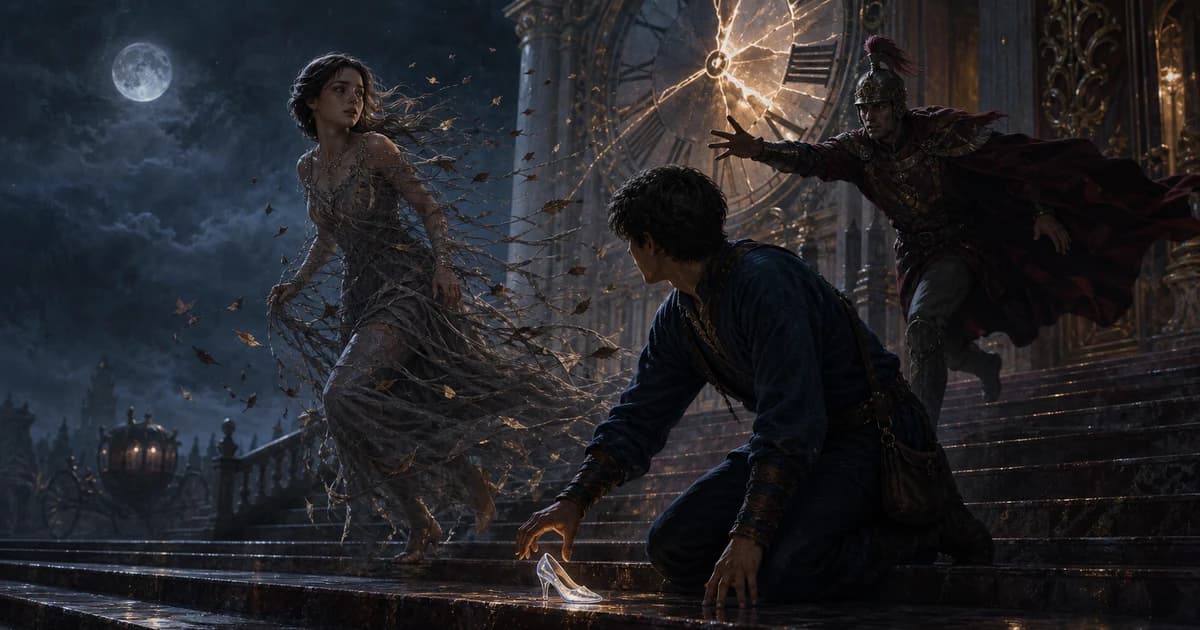
Build the ending as a three-step decision tree
Start with three nodes: who controls the slipper, who learns Cinderella's identity, and who pays for that decision. Follow one branch at a time instead of trying to rewrite the whole fairy tale at once. This branch puts you in the palace messenger's shoes.
You are the palace messenger who spent the evening carrying invitations to people already inside. Nobody asked your name. Nobody noticed when you lent the unknown guest a pin after the hem of her silver dress caught on a rose bush.
Now the silver is gone. Her dress is grey, her carriage is a pumpkin in the road, and she is looking directly at you from the bottom of the steps.
“Please,” she says. She does not point at the slipper or explain what the word means.
The guard is three steps away. The prince is calling from the ballroom. You have time to do one thing before the familiar story closes around all of you.
This scene uses the historic fairy tale linked below as its starting point. The messenger and dialogue are original. It is not a Disney adaptation, uses no Disney design, and is not a released InnerPlay world.
Node one: anchor the branch in the surviving slipper
In the Project Gutenberg text of Cinderella, the second midnight escape leaves one glass slipper behind while everything else returns to its earlier form. That surviving object allows the prince to search for the unknown guest.[1]
An alternative ending does not need a new kingdom, villain or magic system. Change the fate of that one object, then follow the human consequence. Who gets to identify Cinderella? Who controls the story of what happened at the ball? Who is believed?
Node two: choose possession, disclosure and cost
Pick one action before you decide whether it is right. The interesting ending begins with the cost you did not expect.
- Hide the slipper. Cinderella escapes without evidence connecting her to the ball. The prince cannot find her—but neither can the palace turn her into its mystery. Tomorrow, she must decide what freedom looks like without rescue.
- Return it to her. You run down the steps and place the slipper in her hand. She can prove who she was whenever she chooses. The guard sees your face, and helping her may cost you your place at the palace.
- Give it to the guard, then tell the truth. You name the fleeing woman before anybody can invent a princess. The prince knows where to look. Cinderella also knows that you exposed her without permission.
Node three: audit the branch from another viewpoint
The National Film Board's “What if...the story changed?” activity demonstrates how changing one familiar element can open a new version. An ERIC-hosted teaching resource goes further by suggesting a different Cinderella ending from the viewpoints of several characters.[2][3]
That viewpoint shift is useful beyond a classroom. If you tell the ending as the messenger, the question is not simply whether Cinderella marries the prince. It is whether a person with little status protects somebody else's secret when authority demands an answer.
Try the same moment from the guard's view. The stranger may be in danger. The prince may be reckless. Obeying an order could feel like protection rather than cruelty. A stronger alternative ending lets more than one choice make emotional sense.
Stop the branch at Cinderella's response
Whichever action you chose, stop before the reward or punishment. Cinderella turns back. What does she say to you?
If you hid the slipper, she may ask why you assumed she wanted to disappear. If you returned it, she may ask whether you expect gratitude. If you named her, she may tell you that truth offered without consent can still be a betrayal.
Answer her in one sentence. Then write one thing your messenger is willing to lose because of that answer. That is enough to make the old tale feel like a world you briefly affected rather than a plot you only remembered.
Where InnerPlay honestly fits
Cinderella is not available as an InnerPlay story. The current free, accountless prototype is The Last Session, a different psychological-horror experience. You type answers, recognised choices can change local story state, and the prototype reaches an authored outcome with written captioned replies.[4]
There is no live generated conversation, voiced Cinderella or licensed fairy-tale library in this release. If what held you was the pressure of giving a character your own answer, the short demo is the truthful next step.
Continue reading
Questions, answered
- What is a good alternative ending for Cinderella?
- Change one turning point, such as who finds the slipper, and follow the consequence for Cinderella and the person who intervenes. A good ending changes relationships as well as events.
- Does this use Disney's Cinderella?
- No. The scene begins from the historic tale linked from Project Gutenberg and avoids Disney's added dialogue, costumes, characters and visual identity.
- Can I play this Cinderella ending in InnerPlay?
- No. It is an article exercise. InnerPlay currently offers one separate typed prototype, The Last Session.
Sources
- Cinderella, or The Little Glass Slipper — Project Gutenberg. Checked 5 September 2026.
- What if...the story changed? — National Film Board of Canada. Checked 5 September 2026.
- Plan alternative endings to a familiar story — ERIC. Checked 5 September 2026.
- The Last Session: current prototype — InnerPlay. Checked 5 September 2026.