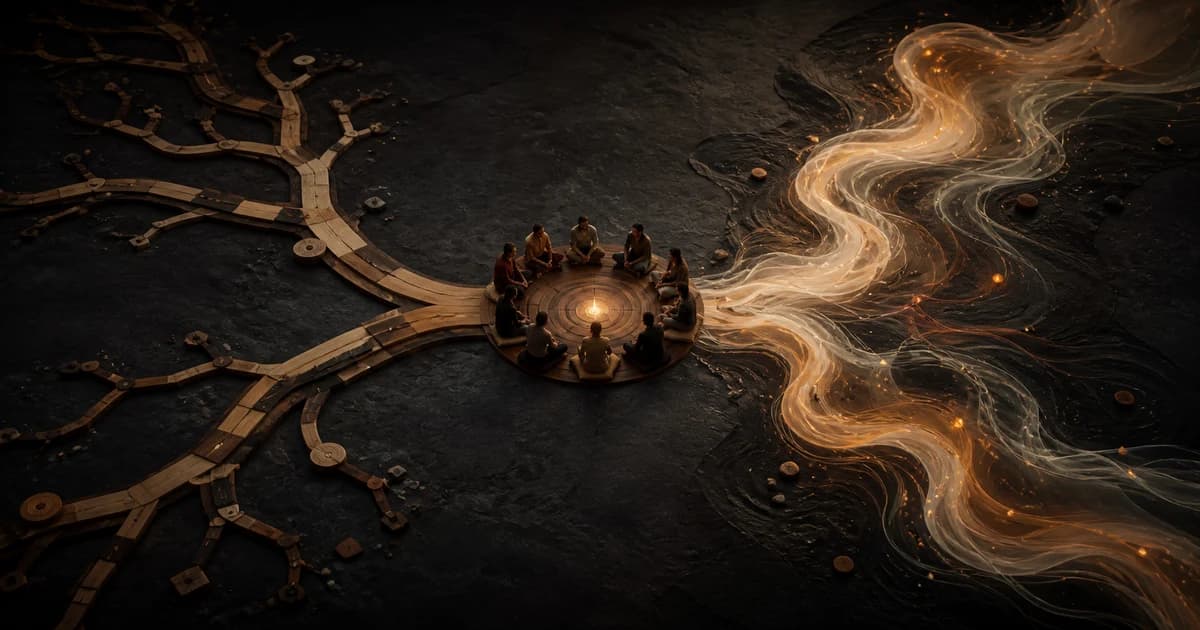
The difference in one table
TWIST's authoring guide shows the branching model clearly: story segments connect through authored choices and recognised utterances. AI Dungeon shows a generative model: the player's history is assembled into context and the system generates the next response, using summaries and retrieved memories when the full adventure no longer fits. These are different production problems.[1][2]
| Question | Branching story | Generative story |
|---|---|---|
| What can I do? | Choose supported routes | Offer broader actions |
| Who wrote the next line? | An author | A model under product rules |
| Are endings known? | Usually | Only if structure constrains them |
| Can it forget? | State bugs are possible | Context and retrieval limits also matter |
| Is replay repeatable? | More repeatable | More variable |
Why authored branches still work
Authored branches let a writer place clues, pace revelations and test every reachable ending. They also grow quickly if every choice forks forever. TWIST's guide recommends merging paths and using meaningful flavour or progress choices instead of fake branches that ignore what the player selected.[1]
The limit is visible freedom. If the only valid actions are the offered options, a player cannot genuinely invent a third approach. That is a design choice, not necessarily a defect: constraint can protect tone and payoff.
Why generated stories need memory and boundaries
Generation can respond to unusual actions, but a long story cannot send an unlimited transcript to a model. AI Dungeon documents context-length limits, summarisation and memory retrieval. Gydel describes building a next scene around an action, while Omea positions its product as structured adventures rather than aimless conversation. The common problem is keeping freedom from dissolving continuity and endings.[2][3][4]
A product should state where generation operates. Is the model allowed to invent world rules, or only dialogue inside an authored beat? Can the player inspect or correct memory? Does the experience promise an ending? Those answers matter more than the model name.
What you can try in InnerPlay
InnerPlay's free prototype offers a small taste of taking a role in a story. You type answers and read captioned placeholder replies. It is not a live generative conversation, and no future story format is promised here.
Sources checked 19 August 2026.
Questions, answered
- Is a branching story generated by AI?
- Not necessarily. Traditional branching stories are authored in advance and select a path from known content.
- Can a generative story have a real ending?
- Yes, if the product constrains generation with authored state, goals or ending rules. Unbounded generation does not guarantee a coherent conclusion.
- Which is better for replayability?
- Branching stories make routes easier to discover and compare; generative stories produce more variation. The better fit depends on whether you value crafted outcomes or broad improvisation.
Sources
- How to Write Interactive Fiction and Audio Stories — TWIST Tales. Checked 19 August 2026.
- What is the Memory System? — AI Dungeon. Checked 19 August 2026.
- Gydel — Gydel. Checked 19 August 2026.
- What is Omea? — Omea. Checked 19 August 2026.